Filling the gap! Sinopec officially releases 60K large-tow carbon fiber
Knowing Carbon fibers with different tow specifications
Main Differences:
1. Appearance and Texture
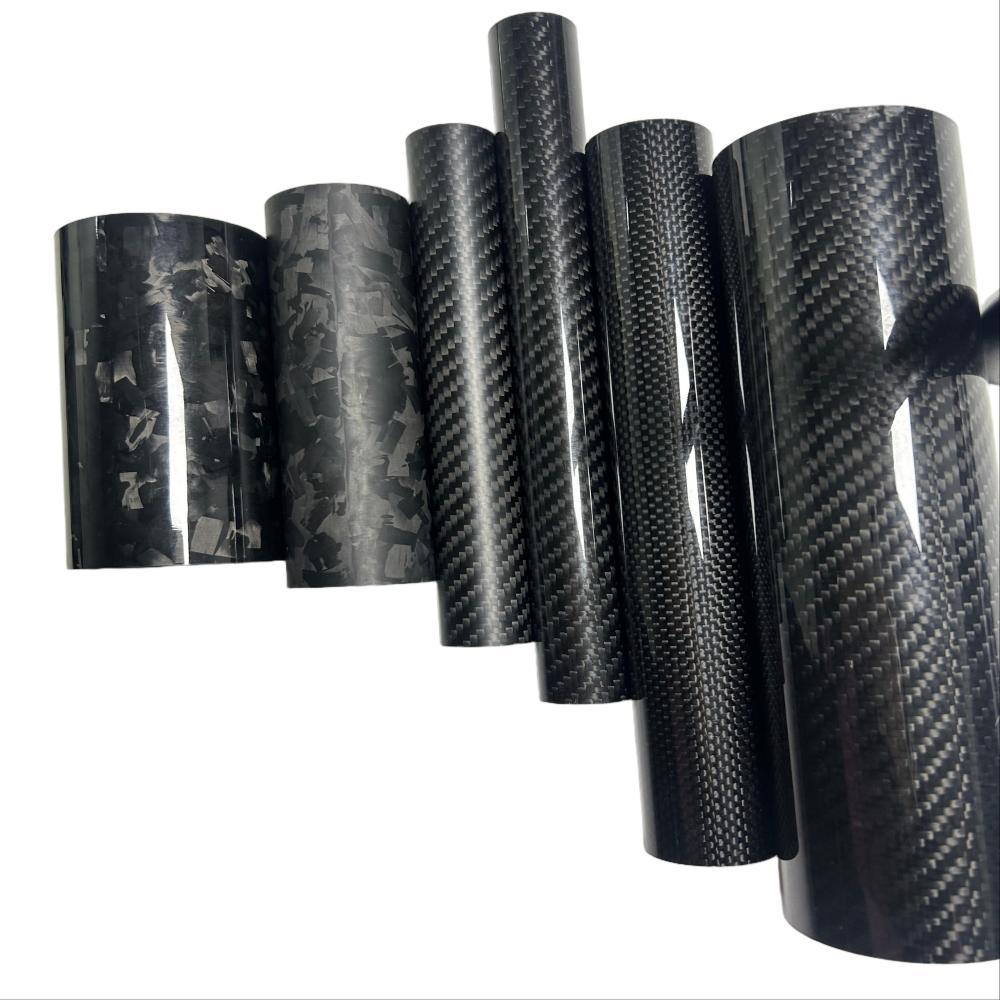
3K: The yarns are finer, resulting in a weave with smaller, denser check patterns (such as plain or twill), creating a refined look. This is currently the most common and popular texture for the exterior layer.
12K: The yarns are coarser, resulting in a weave with larger check patterns, creating a rugged, bold appearance. Its distinctive, wide check patterns are clearly visible from a distance.

2. Weight and Thickness
For the same weave, carbon fiber cloth with a higher kilogram count is generally thicker and heavier. Because a 12k tow contains four times the amount of fiber as a 3k tow, the resulting cloth has a higher gsm (grams per square meter). This allows 12k carbon fiber cloth to be more quickly increased in thickness and strength when manufacturing large or thick components.
3. Flexibility & Workability
3K: The fine tows make the resulting fabric thinner, softer, and more drapable. This means it can better conform to complex curves and mold details, resists wrinkling, and is suitable for manufacturing parts with complex shapes and numerous curves.
12K: The coarse tows make the fabric relatively stiff. When working with large curves or sharp angles, 12K fabric struggles to conform perfectly, and can easily cause fiber hang-ups and wrinkles. It also struggles to bend, making it more challenging to work with complex curves. It is better suited for manufacturing large flat surfaces or parts with less curvature.
4. Strength
This is a common misconception. The strength and stiffness of a single carbon fiber filament do not change depending on whether it is bundled into a 3K or 12K tow. The final strength of the product depends on the grade of carbon fiber used (e.g., T300, T700, T1000), the properties of the resin, the layup design, and the manufacturing process.
However, the k-number does indirectly affect performance. For example, thicker 12K tows have a greater crimp angle during weaving, which theoretically may have a slight impact on performance. However, in practice, for most products, the overall structural design, not simply whether the surface layer is 3K or 12K, determines strength.
5. Cost
From a raw material production perspective, carbon fiber with a higher k-number has a lower production cost per unit weight. This is because the process of manufacturing thousands of micron-sized carbon fiber filaments is complex. Bundling more fibers into a single bundle (e.g., 12K) is more efficient and less expensive than separating them into multiple smaller bundles (e.g., four 3K bundles). Therefore, the raw material price of 12K carbon fiber cloth is generally cheaper than 3K.
6. Resin Wetting Ability
The performance of carbon fiber composites depends largely on the degree of bonding between the carbon fibers and the resin.
3K: The finer filaments provide greater penetration space and a shorter penetration path for the resin, allowing the resin to very evenly and completely impregnate each carbon fiber filament. This effectively reduces internal defects such as bubbles and dry spots (areas not wetted by the resin), thereby ensuring the overall performance and stability of the composite.
12K: The thicker center of the filaments presents a challenge for resin impregnation. If the process is not properly controlled, it can easily result in a situation where the exterior is wet but the interior is dry. This can become a weak point in the entire component, significantly affecting its mechanical properties and durability. Therefore, the use of 12K fabrics generally requires more advanced resin infusion processes (such as RTM or vacuum infusion) to ensure high-quality impregnation.
Major breakthrough
At the 28th China International Composites Exhibition, Sinopec Shanghai Petrochemical officially unveiled its new 60K large-tow carbon fiber product, independently developed. This product, a domestic first, effectively fills a gap in the domestic market and boasts internationally leading performance. Sinopec now boasts production capacity for nearly 20 types of carbon fiber products in various tow specifications, including 24K, 48K, and 60K. This completes a comprehensive product portfolio encompassing both general-purpose and high-performance, as well as large and small tow, contributing to the independent and controllable development of my country's carbon fiber industry chain.
Carbon Filament, Prepreg and Carbon Fiber Cloth
Carbon Fiber Composite Material Compression Molding Process
Related Article